Knowledge Management & Operating Models
FlagshipLaunchedFrom Manual to Operating System
Transforming a 250+ page playbook into a living knowledge ecosystem
- Company
- Intuit
- My role
- Strategy, Architecture & Implementation Lead
- Status
- Launched
- Operating Models & Governance
- Learning & Capability Transformation
Context
Transforming a 250+ page playbook into a living knowledge ecosystem.
At a glance
- Company: Intuit
- Category: Knowledge Management & Operating Models
- Role: Strategy, Architecture & Implementation Lead
- Status: Launched
The Challenge
The team's primary instructional-design reference had grown into a 250+ page Word document. Guidance was dense and difficult to navigate, related standards appeared in multiple places, structure and tone varied, and there was no reliable version-control or ownership model.
My Role
I owned the initiative end to end: diagnosing the usability problem, gathering user feedback, creating the future-state strategy and information architecture, designing the content model, building the Confluence framework and content, and establishing governance.
The Approach
Before
- 250+ page Word document
- Linear navigation
- Dense mixed-content sections
- Duplicated standards
- Limited visual guidance
- One experience for every role
- No clear ownership
- Ad hoc maintenance
After
- Modular Confluence knowledge hub
- Search, tags, and cross-links
- Task-based pages
- Single-source-of-truth standards
- Workflows, checklists, and visual references
- Role-based guidance
- Defined content ownership
- Quarterly governance and feedback
The Solution
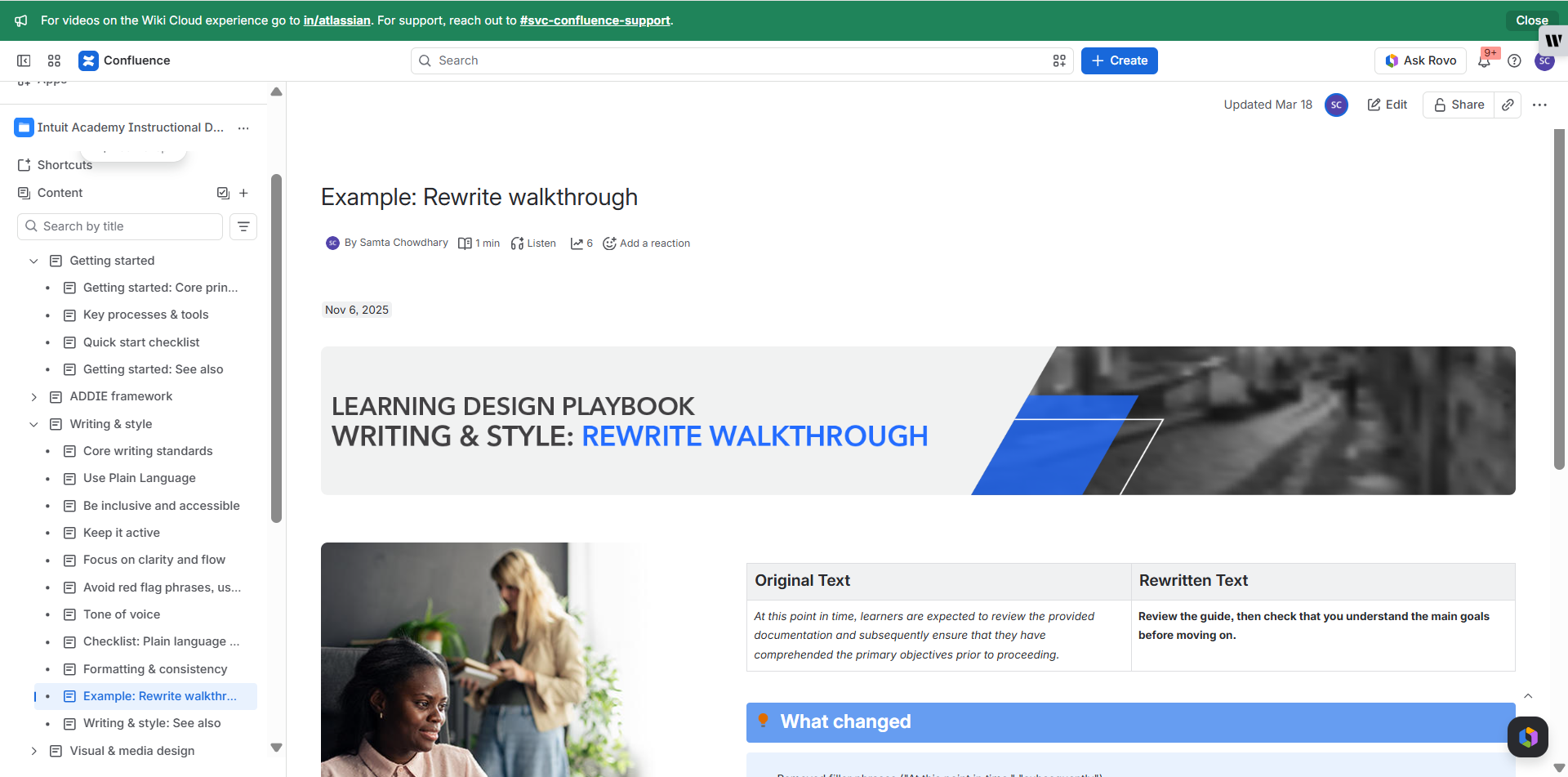
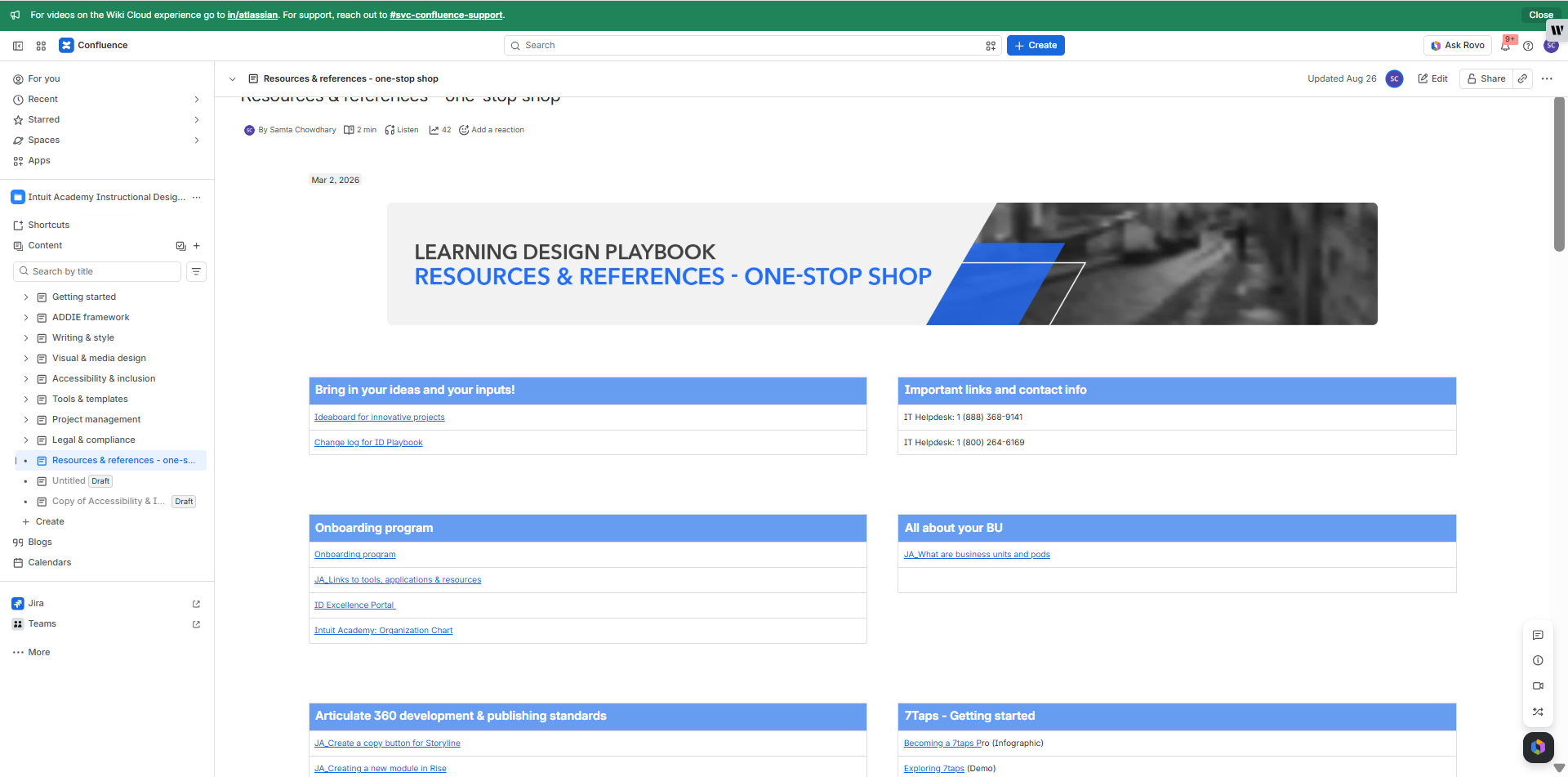
The redesigned Playbook was built and launched as a live Confluence knowledge hub.
Visual evidence
What Changed
The redesign moved the Playbook from a static reference document to a structured knowledge environment designed for ongoing use, maintenance, and evolution.
- 01
Discoverability — Standards and resources organized around tasks and needs rather than document pages.
- 02
Consistency — Shared guidance, examples, and standards consolidated into a common environment.
- 03
Maintainability — Modular content could be updated without republishing and redistributing a large document.
- 04
Scalability — The framework created a foundation for expanding guidance, resources, onboarding, and team knowledge over time.
A 50% improvement in information-access time was established as a design target; post-launch measurement was not completed.
What This Demonstrates
- Operating Models & Governance
- Knowledge Management
- Learning & Capability Transformation
- Information Architecture
“Good systems make the right information easier to find, easier to use, and easier to maintain.”